
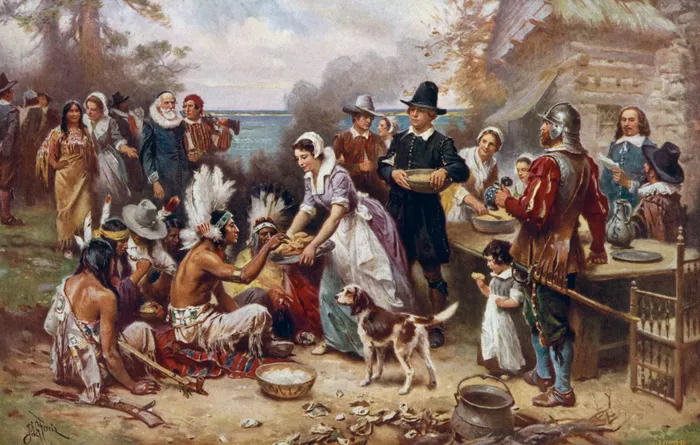
You’ve probably heard the classic story — in 1621, the Pilgrims and the Wampanoag people shared a feast in Plymouth, Massachusetts, to celebrate the year’s harvest. That warm image, full of gratitude, community, and roasted food, is often called the “First Thanksgiving.”
But here’s the twist: Thanksgiving didn’t instantly become a national holiday. In fact, it took more than 300 years of tradition, persuasion, and political effort for it to officially earn that title.
So, when exactly did Thanksgiving become a holiday? And how did it evolve from a local celebration to a symbol of American unity and family togetherness?
In this article, we’ll travel through history step by step — from that 1621 feast to the 1941 law that finally made Thanksgiving a permanent national holiday. Don’t worry, we’ll keep things simple, lively, and packed with interesting stories. Think of this as your time machine back to the origins of one of America’s most beloved holidays.
The Earliest “Thanksgiving”: From Harvest to Celebration
A Feast of Gratitude
The story begins in the autumn of 1621, when the English Pilgrims of Plymouth Colony celebrated their first successful harvest. They invited about 90 Wampanoag people to join them for a three-day feast. There was venison, wild fowl, corn, shellfish, and other foods from the land.
However, the word “Thanksgiving” wasn’t used at the time. The Pilgrims simply wanted to thank God for survival and the harvest — something like a “thank-you dinner” rather than an official holiday.
In fact, “thanksgiving” days were already part of European culture. People in England and other countries would hold religious “days of thanks” after good harvests or major victories. So, it’s more accurate to say the 1621 feast was one of many early thanksgivings, not “the first Thanksgiving Day.”
From Feast to Tradition
As time passed, New England colonies started holding their own days of prayer and thanksgiving in the autumn. Governors would declare such days to thank God for good weather, peace, or plentiful crops.
It was a bit like how families today pick different weekends for reunions — same spirit, different timing. Each colony (and later each state) had its own version of a Thanksgiving celebration.
By the 1700s, this habit became a regional custom in New England. Still, there was no single nationwide date, no official law, and no set tradition.
In short: Thanksgiving began as a community feast, a way to say thanks for survival and harvest, but it was not yet a holiday recognized by the whole country.
From Local Feasts to National Calls: The Birth of a Holiday Idea
The Early Government’s Involvement
After the American Revolution, leaders wanted to create moments of unity for the new nation. In 1789, President George Washington issued the first national Thanksgiving Proclamation, recommending a day of public prayer and gratitude on November 26.
That was the first time Thanksgiving was recognized by the federal government. But here’s the catch — it was a one-time event, not an annual holiday. Each president or governor afterward could decide whether to call for a Thanksgiving or not.
Sarah Josepha Hale — The Woman Behind the Holiday
Now enters a true hero of the story: Sarah Josepha Hale, a magazine editor and the author of “Mary Had a Little Lamb.” For over 30 years, she wrote letters to governors, presidents, and members of Congress, urging them to make Thanksgiving a national annual celebration.
Think of her as the holiday’s biggest fan — she never gave up. Hale believed that a shared day of gratitude could bring the country together, especially during times of division.
Abraham Lincoln’s 1863 Proclamation
During the dark days of the Civil War, President Abraham Lincoln responded to Hale’s campaign. On October 3, 1863, he proclaimed a national day of Thanksgiving to be celebrated on the last Thursday of November.
This was a powerful symbolic act. Amid war and loss, Lincoln called on Americans to unite in thankfulness and healing. His proclamation is often seen as the birth of the modern Thanksgiving holiday.
Still, this was not yet a permanent law — presidents continued issuing yearly proclamations, but the date and observance could vary.
The Legal Birth of the Holiday: From Tradition to Law
States Aligning Around a Common Date
By the late 1800s, most states had adopted the practice of celebrating Thanksgiving on the last Thursday of November, following Lincoln’s lead. Newspapers printed Thanksgiving menus, schools taught its meaning, and families made it part of their annual routine.
Still, the date wasn’t officially uniform. Some states followed the president’s declaration each year, while others chose their own Thursday.
The Roosevelt Controversy
Then came a twist. In 1939, President Franklin D. Roosevelt decided to move Thanksgiving a week earlier — to the second-to-last Thursday of November. Why? He wanted to lengthen the Christmas shopping season and boost the economy.
Many people disliked this change. Some called it “Franksgiving.” States were split — half followed Roosevelt’s new date, half kept the traditional one. Families were confused, travel plans went wrong, and people demanded consistency.
1941: Thanksgiving Becomes a Federal Holiday
Finally, to settle the confusion, Congress passed a law in December 1941 declaring that Thanksgiving would be celebrated every year on the fourth Thursday of November. President Roosevelt signed it into law.
That law made Thanksgiving a permanent, nationwide holiday — with a fixed date, just like Christmas or Independence Day.
Analogy: Imagine your family used to celebrate your birthday on random weekends, depending on everyone’s schedule. Then, one year, you decide: “From now on, it’s always the last Saturday of November!” That’s what the 1941 law did for Thanksgiving.
Thanksgiving Timeline: The Key Milestones
Let’s review the turning points quickly:
1621 — Pilgrims and Wampanoag share a harvest feast in Plymouth.
1789 — George Washington declares a national day of thanksgiving on November 26.
1863 — Abraham Lincoln proclaims a national Thanksgiving Day on the last Thursday of November.
1939 — Franklin D. Roosevelt changes the date to the second-to-last Thursday.
1941 — Congress passes a law making Thanksgiving an official holiday on the fourth Thursday of November.
Each of these moments marks a step in Thanksgiving’s slow transformation — from local feast to national tradition, and finally to a permanent holiday.
Why Did Thanksgiving Become a National Holiday?
A Tool for National Unity
In the 1800s, America was growing and changing rapidly — wars, westward expansion, and new waves of immigration made the country diverse but divided. Thanksgiving offered a chance for everyone to pause, reflect, and feel connected to a shared identity.
President Lincoln used the holiday to remind Americans that even in times of hardship, they had much to be thankful for. It was more than just food — it was about healing and hope.
A Pause in Modern Life
Holidays serve an important psychological purpose. They force societies to slow down and appreciate what they have. For early Americans, Thanksgiving became that pause — a day to stop working, cook, gather, and express gratitude.
In today’s world, we might compare it to taking a “national deep breath.”
Economic and Political Reasons
By the 20th century, Thanksgiving also had a commercial angle. The long weekend fueled travel, shopping, and business. “Black Friday” — the day after Thanksgiving — became one of the biggest retail days of the year.
So, while the heart of the holiday remains gratitude, the economy definitely played a role in shaping its modern form.
The Impact and Meaning of Thanksgiving Today
A Day for Family and Gratitude
Once Thanksgiving became a national holiday, it quickly became part of American family life. Today, more than 55 million Americans travel each year to celebrate it — making it one of the busiest travel times of the year.
Families gather around tables filled with turkey, stuffing, cranberry sauce, and pie. More importantly, they take time to express gratitude — sometimes aloud, sometimes quietly. It’s about saying “thank you” for what life brings, big or small.
Cultural Symbolism
Thanksgiving holds a unique place among American holidays.
- It’s not tied to any specific religion.
- It celebrates a universal emotion — gratitude.
- It kicks off the “holiday season” that continues through Christmas and New Year’s.
In short, Thanksgiving is both personal and national, ancient and modern, spiritual and social.
Challenges and Reflection
Yet, the holiday also has deeper historical layers. For Native Americans, Thanksgiving can be a reminder of colonization, loss, and cultural erasure. Many Indigenous communities hold a National Day of Mourning on the same date to honor their ancestors and reflect on history.
Meanwhile, others critique how consumerism has overshadowed gratitude — turning the season into a shopping frenzy. Still, many Americans seek to reclaim its original purpose by volunteering, donating, or spending time with loved ones.
Understanding Thanksgiving Through Nature — A Reptile Analogy
Since I’m both a holiday scholar and a reptile expert, let’s make an unusual comparison.
Think of Thanksgiving as a green iguana basking in the sun. Iguanas are calm, slow-moving reptiles that rely on steady warmth to thrive. They don’t rush; they adapt over time.
Similarly, Thanksgiving didn’t rush into being. It slowly absorbed traditions, gained supporters, and found its ideal “temperature” — that perfect balance between faith, family, and national pride.
Like the iguana’s steady heartbeat under the sunlight, Thanksgiving has survived through centuries of change because it’s built on something simple and enduring — gratitude.
Conclusion: The Long Climb to a National Holiday
From the 1621 harvest feast to the 1941 federal law, Thanksgiving’s journey took over three centuries. Along the way, it grew from a local prayer day to a nationwide celebration of unity, gratitude, and togetherness.
If you take one thing from this story, it’s this:
Thanksgiving became a national holiday not in a single moment, but through centuries of gratitude, faith, and persistence.
So, next time you gather around the table, carving a turkey or saying thanks, remember — you’re not just enjoying a meal. You’re taking part in a story that began long before you, slowly evolving, like a patient reptile warming under the American sun.
Related topics: