
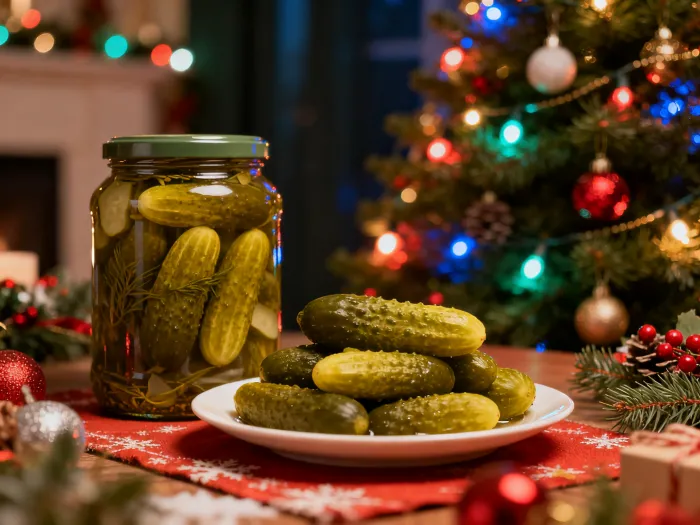
The Christmas season is filled with unique customs and traditions, many of which have mysterious origins. Among these is the curious practice known as the “Christmas pickle.” Every year, families across North America hang a green glass pickle ornament in their Christmas tree. The first child to find the hidden pickle on Christmas morning is said to receive an extra gift or good luck for the year. But where did this quirky tradition come from? Despite its popularity, the roots of the Christmas pickle are shrouded in uncertainty and myth.
A Brief Description of the Christmas Pickle Tradition
The Christmas pickle is typically a glass ornament shaped like a cucumber or gherkin. On Christmas Eve, parents hide this pickle deep within the branches of the Christmas tree. On Christmas morning, children eagerly search for it among twinkling lights and colorful decorations. The finder is often rewarded with a small prize, such as an extra present or the privilege of opening the first gift. This playful ritual adds an element of excitement to holiday festivities and encourages children to appreciate family traditions.
Popular Legends and Myths
Several stories attempt to explain how the Christmas pickle became part of holiday celebrations. One widespread tale suggests that the tradition originated in Germany, known there as “Weihnachtsgurke.” According to this legend, German families have long hidden pickles in their trees to bring luck and prosperity. However, when surveyed, most Germans are unfamiliar with this custom, casting doubt on its supposed origins.
Another story recounts the plight of a Bavarian prisoner during the American Civil War. Allegedly, he begged a guard for a pickle on Christmas Eve, which saved his life and inspired him to introduce the tradition to his family after his release. While touching, there is little historical evidence to support this narrative.
Commercial Influence and Glass Ornament Production
The most plausible explanation points to late 19th-century American marketing efforts. During this time, German glassblowers began exporting delicate ornaments shaped like fruits and vegetables—including pickles—to the United States. American retailers seized upon these imported decorations and created stories around them to boost sales during the holiday season. Catalogs and advertisements promoted the idea that hanging a pickle was a cherished Old World tradition, even though its roots were likely invented for commercial purposes.
Cultural Adoption in America
By the early 20th century, the Christmas pickle had become a fixture in American households, particularly among families with German ancestry or those living in regions with strong German-American communities. Over time, it spread beyond these groups and entered mainstream holiday culture. Today, stores across North America sell a variety of pickle ornaments each year, often accompanied by cards explaining how to play the “pickle game.” The tradition continues to thrive, enjoyed by generations eager for festive fun.
Debunking Common Misconceptions
Despite its association with Germany, most evidence suggests that Germans do not widely observe this custom. Folklorists have found no mention of pickles in traditional German Christmas celebrations or literature before American sources began referencing them. The misconception may stem from confusion between imported German ornaments and invented folklore used for marketing purposes.
Symbolism and Modern Interpretations
For many families today, the Christmas pickle symbolizes more than just playful competition—it represents togetherness, anticipation, and shared memories. Whether or not its origins are genuinely ancient or authentically German seems less important than the joy it brings to those who celebrate it. Each family may interpret its meaning differently: some see it as a sign of good fortune; others simply enjoy searching for something unexpected amid familiar decorations.
Conclusion
The tradition of hiding a Christmas pickle in the holiday tree may not be as old or as German as once believed. Its true roots lie in creative marketing and cultural adaptation rather than centuries-old folklore. Nevertheless, it remains a beloved part of many families’ holiday celebrations—proof that even invented customs can become cherished rituals over time.
Related topics: